


.png)


%20(22)_edited.jpg)
What We Teach Our Children by What We Tolerate
Children are always watching. They learn what matters not primarily from what adults tell them, but from what adults do, especially in moments of tension, fear, and uncertainty. Long before they understand policy or politics, they absorb lessons about who belongs, who is protected, and what kind of behavior is acceptable when power is involved.
Right now, our country is offering such a lesson.
Over the past several weeks, immigration enforcement has once again intensified. Raids, detentions, and sweeping actions have returned to the center of public life, accompanied by rhetoric that frames human beings as threats rather than neighbors. These developments are often discussed as strategy or policy, but for many people, especially young people, they appear simply as images and stories scrolling across screens, overheard conversations, or sudden absences in classrooms and neighborhoods.
This moment did not emerge out of nowhere. Escalation has become a governing style rather than a last resort. Repetition has normalized what once shocked. As enforcement becomes more aggressive and more visible, the moral consequences become harder to ignore.
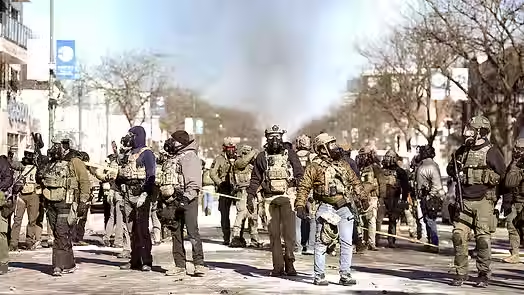
That visibility now extends beyond immigration itself. In Minneapolis, protesters and legal observers responding to recent enforcement actions have been met with heavily armed federal agents, aggressive crowd-control tactics, and force more commonly associated with conflict zones than civic dissent. Video footage of protesters being threatened, dispersed with chemical agents, and treated as enemies has circulated widely. For children watching, whether in living rooms, on phones, or on the streets themselves, the message is unmistakable: dissent is dangerous, and state power is not to be questioned.
Now in two recent instances tied to this escalation, enforcement ended in death. Video of those moments circulated widely, viewed, shared, debated, and then, by many on the right, moved past. The pattern: when violence becomes a foreseeable outcome of policy, and when both death and repression are met with normalization, something deeper is at stake than enforcement strategy.
Moments like these raise a difficult but necessary question: What are we teaching our children by what we tolerate?
There is a concept in education known as the “hidden curriculum”, the unspoken lessons conveyed not through formal instruction, but through norms, behaviors, and omissions. Societies have hidden curricula, too. Children learn who counts by watching who is protected. They learn whose pain matters by observing what generates outrage and what draws indifference. They learn how authority operates by seeing whether power is exercised with care or with impunity.
We teach values not only through action, but through silence. When fear is used to justify cruelty, when escalation leads to irreversible harm, and when peaceful protest is treated as a threat requiring militarized response, young people notice. They internalize lessons about disposability, obedience, and the fragility of basic rights.
This is especially dissonant in a country that prides itself on fairness, compassion, and respect for the rule of law. These values are frequently invoked, but values are not abstractions. They are revealed in how laws are enforced, how dissent is handled, and whether restraint accompanies authority. Law without justice is not virtue. Order without dignity is not strength.
Strength, in fact, is often misunderstood. It is not found in intimidation, spectacle, or domination. It resides in restraint, accountability, and moral clarity—especially when dealing with those who have the least power to resist harm. A society that confuses cruelty for strength teaches a dangerous lesson about leadership and worth.
History has a long memory. It rarely remembers the technical justifications offered at the moment. It remembers what was normalized, what was excused, and what was quietly accepted as necessary. Again and again, we see that legality (and that is questionable) and morality are not the same, and that silence, too, is a form of participation.
Children may not remember the specific policies of this era. They are unlikely to recall agency names or executive orders. But they will remember the examples set before them: how authority responded to vulnerability, how power treated dissent, and whether humanity was defended or denied.
Responsibility in moments like this does not require heroics. It does not demand perfection. It begins with refusing dehumanization, choosing language carefully, and being honest, especially with young people, about what they are seeing. It includes staying present rather than numb, compassionate rather than cynical, and willing to question what is presented as inevitable.
The lesson is being taught whether we intend it or not. The question is not whether children are learning from this moment, but what, exactly, they are being asked to learn.
That lesson is still being written; and it is shaped, every day, by what we choose to tolerate and what we decide is worth standing against.


Comments